
Scaling Questions
- Johanna Wegner
- Jan 31
- 3 min read

Methods Monday: Scaling Questions - Gaining clarity and making progress visible
Some topics feel difficult to grasp. Not necessarily because they are especially complex, but because many things are happening at once: thoughts, emotions, expectations, inner doubts.
In moments like these, it can help to pause and bring some order to one’s own perception. Not to find an immediate solution.But to consciously notice where you currently stand.
Scaling questions support exactly this process. They create a clear and structured framework in which inner states, assessments, and developments become tangible, without being judged or relativised. In my coaching work, I often use this method when orientation is missing or progress feels hard to articulate.
What are scaling questions?
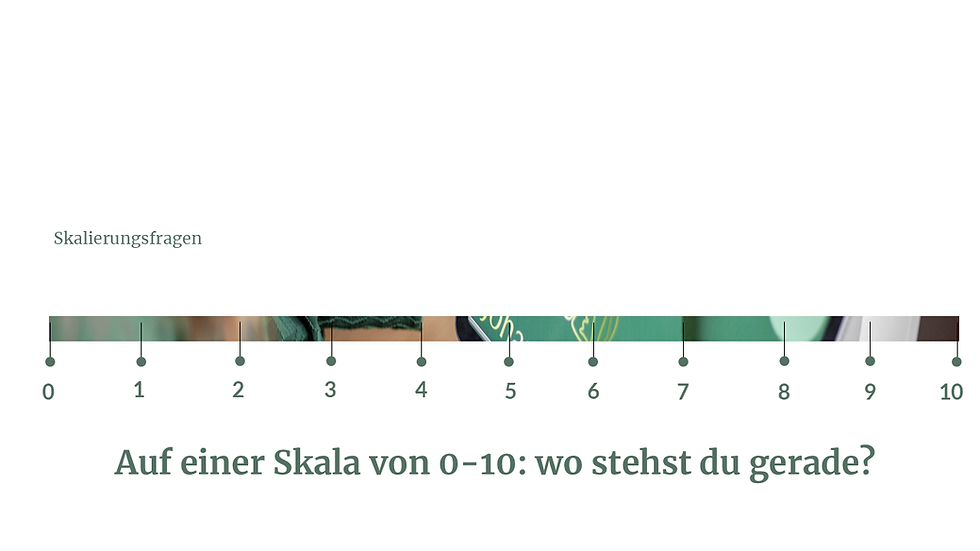
Scaling questions are a classic solution- and resource-oriented coaching technique. They invite you to place a topic on a scale, usually from 0 to 10.
0 stands for “not present at all”, “very low”, or “highly challenging”
10 stands for “fully achieved”, “very high”, or “optimal”
The number itself is not the goal. What matters is what becomes visible through the process of positioning: personal perceptions, differences, inner evaluations, and possible next steps in development.
Scaling questions help to structure diffuse impressions, clarify priorities, and consciously perceive differences. They reduce complexity without oversimplifying.
Why scaling questions are so effective
Many people experience their situation in terms of “either good or bad”. Scaling questions open up a more nuanced perspective.
Instead of thinking in opposites, space emerges for gradations:
not perfect, but not at the beginning either
challenging, but not hopeless
An important aspect here is the focus on differences. Through carefully chosen follow-up questions, it becomes clear what makes a certain rating feel accurate and what has already enabled change.
Typical follow-up questions include:
What makes this number feel right for you?
How would you notice that you have moved one point higher?
What is already present that keeps you from rating yourself lower?
This creates access to resources that often go unnoticed in everyday experience.
How I use scaling questions in coaching
In coaching, I use scaling questions intentionally to create orientation and support development processes.
They are particularly helpful for
putting emotional states into words,
making progress within a process visible,
understanding change as a gradual path.
Often it becomes clear that people experience their situation as very challenging, yet rarely place themselves at zero. This is where an important lever lies: attention shifts to what is already supporting and working.
Scaling questions do not steer or evaluate. They remain open and respect the subjective reality of the person being coached. The assessment emerges from personal perception, not from external standards.
Typical areas of application
Scaling questions can be used in many contexts, including
decision-making processes
goal clarification and self-assessment
phases of change and development
self-efficacy, motivation, and stress
leadership, collaboration, and team processes
They are suitable for individual coaching as well as for team settings and workshops.
Scaling questions as a process tool
One particular strength of scaling questions lies in their process-oriented nature. They make development over time visible.
Repeating a scaling question throughout a coaching process highlights not only change, but also invites reflection:
What contributed to this shift?
What was done differently, consciously or unconsciously?
Which conditions were supportive?
In this way, development becomes tangible and acknowledged, even when it happens in small steps.
Reflection prompt
If you place your current topic on a scale from 0 to 10:
Where do you stand right now?
What makes sure you are not standing lower?
And what would make a small next step upwards possible?
Not as a task.But as an invitation to observe your own perception more consciously.
Conclusion
Scaling questions remind us that development rarely happens in leaps.T hey invite us to recognise that change often unfolds through small, intentional steps.
By making differences visible, they create orientation where there was uncertainty before. Not to accelerate or optimise, but to notice what is already present and what may become possible next.
This is where their strength lies: scaling questions connect inner perception with clarity and open up a realistic, manageable view of development.
If you notice that you keep circling around a topic or find it difficult to clearly name your own position, an external perspective can be helpful.
In coaching, I use scaling questions to create orientation, make development visible, and consciously shape next steps.
If you are curious about how this or other methods could support you in your current process, feel free to reach out for an informal, no-obligation conversation.
Yours, Johanna


Comments